

Employers have a number of obligations when it comes to KiwiSaver. We detail what the contribution includes, how much an employer has to contribute, the rules employers must abide by and more.
If you’re employed and contributing towards KiwiSaver, your employer has to contribute too. This often overlooked KiwiSaver benefit adds up to a significant percentage of your wealth over time, so it’s important to have an understanding in order to take full advantage. We’ve detailed the important aspects of employer KiwiSaver contributions below.
What are KiwiSaver Employer Contributions?
KiwiSaver employer contributions are the KiwiSaver contributions that your employer pays, typically on top of your personal employee contributions of between 3% and 10%. If you contribute towards your KiwiSaver account, and meet the rules, your employer must also contribute.
How much do employers have to contribute to KiwiSaver?
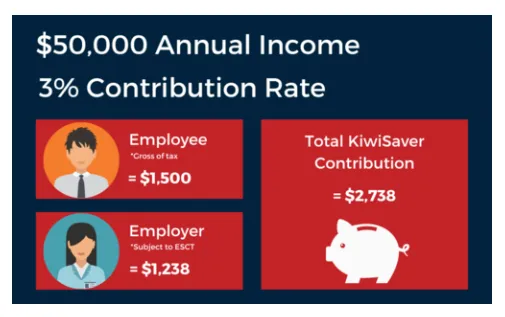
Employers have to contribute a minimum of 3.5% of your gross salary towards your KiwiSaver account. But, if you personally contribute 3.5% of your salary towards your KiwiSaver account, and your employer matches that, you will notice a difference between the two contributions. That’s because your employee contributions are gross of tax, whereas your employer contributions are subject to employer superannuation contribution tax (ESCT). It’s easier to see this difference with a general example.
If you earn $50,000 and contribute 3.5% towards KiwiSaver, you will personally contribute $1,750/year towards your KiwiSaver account [$50,000 x 3.5%], while your employer will contribute $1,443.75/year towards your KiwiSaver account [$50,000 x (3.5% x (1 – 17.5 tax%)].
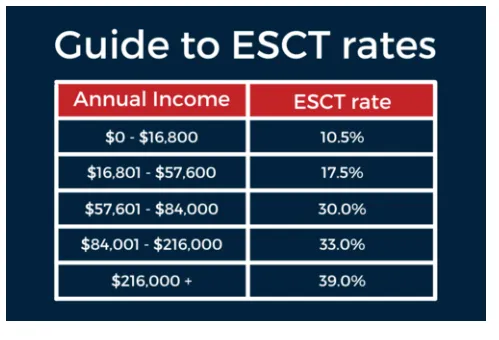
These employer superannuation contribution tax rates are determined based on your income for the most recent year ended 31 March, and are detailed in the accompanying table.
Does your employer have to match your KiwiSaver contribution?
Your employer must match your KiwiSaver contributions to at least 3.5% of your gross pay if you meet the following criteria:
- You must not be under the age of 16 (From 1st April 2026, 16- and 17-year-olds are also entitled)
- You must not be aged 65 or older
- If your employer already contributes at least 3.5% of your gross pay towards another eligible registered superannuation scheme, they do not need to also match your KiwiSaver contributions.
The majority of the time your employer’s KiwiSaver contributions are paid on top of your gross salary or wage. However, the only instance in which your employer KiwiSaver contributions are included to reach your overall gross pay is if you and your employer acknowledge in your employment agreement that your overall pay was inclusive of KiwiSaver matched contributions. If you did agree to this, your employment agreement must include a ‘total remuneration’ clause clearly stating that this is the case.
What if my employers KiwiSaver contributions are more than 3.5%?
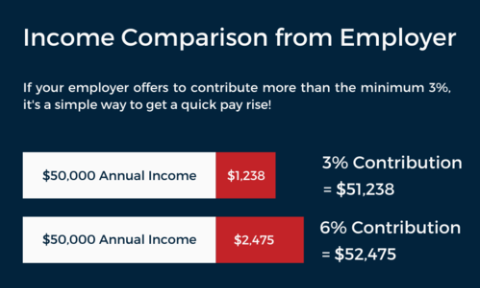
If your employer matches your KiwiSaver contributions up to more than the legal minimum of 3.5%, then it’s in your best interests to increase your personal contributions to make the most of this free money. For instance, if your employer offers to match your KiwiSaver contributions up to 6%, then by increasing your KiwiSaver contributions from 3.5% to 6%, you are essentially getting a 2.5% pay rise just by making a small change.
Still unsure on your situation when it comes to KiwiSaver employer contributions?
I advise Kiwi’s free of charge on how to get the most out of KiwiSaver. For some, that means helping them find the ideal fund, but for many it can be something as simple as general guidance and a personal point of contact for any questions. If you’ve got some questions about your KiwiSaver investment, then please get in touch here and I will be happy to help.